FREQUENTLY ASKED QUESTIONS
What tax information do I need to drop-off/mail-in to you?
I have created a list of commonly needed items to successfully complete most returns. You may view the list here. Note: PDF viewing software (such as Acrobat Reader) is required.
What does AFSP stand for?
An "AFSP" is a voluntary program set up by IRS. It stands for Annual Filing Season Program. The AFSP designation is renewed annually. The IRS does not endorse any particular individual tax return preparer. For more information on tax return preparers, go to IRS.gov.
Requirements for an AFSP:
- A preparer with AFSP-Record of Completion designation has completed the required continuing education covering tax law issues, individual tax return preparation and ethics.
- Must be age 18 or older, registered with the IRS and have a valid Preparer Tax Identification Number (PTIN).
- Must complete 15 hours of continuing education courses each year.
- Must renew PTIN annually.
- Must adhere to ethical standards.
Do you share information?
We do not disclose your information to anyone without your written permission, unless legal required to do so. Please see our Privacy Policy. If you need information provided to a third party, such as a Bank or Mortgage Company, please contact us. We will provide you with the appropriate form which will allow us to forward your specified information to the third party.
How long should I keep my Tax Returns?
We recommend that you keep your tax returns, and any information that supports the numbers on the tax return, FOREVER! (i.e., W-2’s, 1099’s, 1098’s, receipts etc.) Let your heirs/beneficiaries get rid of the tax returns.
There are two reasons:
- The IRS has a loop hole to their 3 year rule. If the IRS suspects fraud, there doesn’t have to be fraud, but if they suspect it, they can go back and examine any year that they want. What were you doing 10 or even 15 years ago? Would you remember where you worked or lived? Would you be able to get W-2’s from those employers? The tax return and supporting documents is the easiest way to remember!
- Your tax return can also be used for Social Security purposes. If the Social Security Administration does not have your correct income work record and information, the easiest way to prove it is your tax return. Some of my clients have had to do this. Luckily, they followed this advice and had their tax returns for the years in question.
Keep Receipts for Home Improvements?
Yes, please keep all receipts for major home improvements, even if you qualify for IRS Section 121 Exclusion on the Sale of a Principal Residence. Those receipts/expenses will be added to the original purchase price of the property to help determine any profit/gain on the home. If there is a gain, the tax law is then applied to see if you have any taxable profit/gain. If you meet the qualifications, up to $500,000 gain (married filing joint) or $250,000 gain (single) can be excluded from income. Of course a loss on a personal residence is never deductible.
In many states, the gain from the sale of a home, even if not taxable by Federal, is required to be included in household resources for purposes of determining the eligibility to file for certain credits. Michigan is one of those states that require the profit/gain on the sale of a home to be included in Household Resources, even if it is not taxable. Household Resources are used in Michigan to determine eligibility to file for the Homestead Property Tax Credit (MI-1040CR) and Home Heating Credit (MI-1040CR-7) Forms.
Will we get all possible deductions and credits?
We try hard to ask you about every possible deduction or credit, but with the number of changes each year, we need your help to make sure this happens. Please ask us about any items which you think may relate to your tax situation.
Charitable Contributions requirements?
The IRS requires documentation for all contributions to qualified 501(c)(3) organizations. See IRS Publication 526, Charitable Contributions, for more detailed information on the record keeping requirements and what qualifies as a charitable contribution that can be deducted on the tax return.
Please note that there is no standard deduction for charitable giving. The amount that can be claimed as a deduction depends upon if the appropriate record/receipt is received to verify the contribution. Please be sure to review IRS Publication 526 to verify the receipt that was received is acceptable.
Here are a few examples of the record keeping requirements:
If you give cash at Church or put money in the bell ringer’s pot and no receipt was received, you have no proof therefore you have no deduction for that contribution.
If you purchase items to donate, you must give the store receipt to the organization and the organization must then issue you a receipt showing the items received and the value donated.
If the contribution is under $250, documentation can be a canceled check, bank record, or letter from the charitable organization.
Single contributions that are $250 or more require a receipt from the organization. The receipt must also state whether goods or services were received in exchange for the contribution. If no goods or services were received, the receipt must include a version of this statement in order to be used for tax purposes, "no goods or services were received in exchange for the contribution” or “only intangible religious beliefs were received in exchange for the contribution”. This type receipt applies only to single contributions of $250 or more and the receipt must be dated and received prior to the filing of the tax return otherwise IRS will disallow the deduction.
For clothing/furniture/household items, make sure you have an itemized list of the items donated. Document the number of pants, shirts, etc., and the fair market value of those items. When you receive the receipt from the organization, attach the itemized list to the receipt. Many times if you ask, the organization has handouts that help determine the fair market value of the items donated.

IRS's Frequently Asked Questions.
Michigan's Frequently Asked Questions
Lansing's Frequently Asked Questions
Our Blue Folders
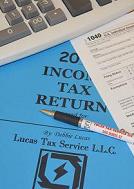
For decades, we have used the same style Blue Folders to provide clients with their tax returns and supporting documents. Clients have requested that we never change this tradition because they recognize these Blue Folders as important tax documents.